
Under the floor in a humid climate
Crawl Space Encapsulation & Insulation in Tallahassee, FL
Stop the musty smell, sagging batts and sticky floors that come from summer air moving under the house.
- Free in-person estimates
- Written quotes that list foam type, thickness and R-value for each area
- Roof leaks, damp wood and termite clearances checked before we spray
Why Crawl Spaces Struggle in North Florida
Crawl space encapsulation and insulation means sealing the space under a house from outside air and ground moisture, then insulating it so the floor above stays comfortable. It suits the many older homes in Tallahassee, Quincy, Havana and Monticello that sit on piers or block foundations over a vented crawl space, and raised homes near the coast. Signs you need it: a musty or earthy smell inside, floors that feel damp or cupped, insulation batts hanging down or lying on the ground, rusty ductwork, or standing water after storms.
The humidity problem
Venting a crawl space sounds like a way to dry it out, but in a hot, humid climate it often does the opposite. Wikipedia's figures for Tallahassee show average relative humidity around 80% in July and about 59 inches of rain a year. When summer air drifts into the crawl space and meets floor framing and ducts cooled by the air conditioning above, moisture condenses. Fiberglass batts between the joists soak it up, get heavy and fall. Wood stays damp, which invites mold and wood-destroying insects.
What encapsulation involves
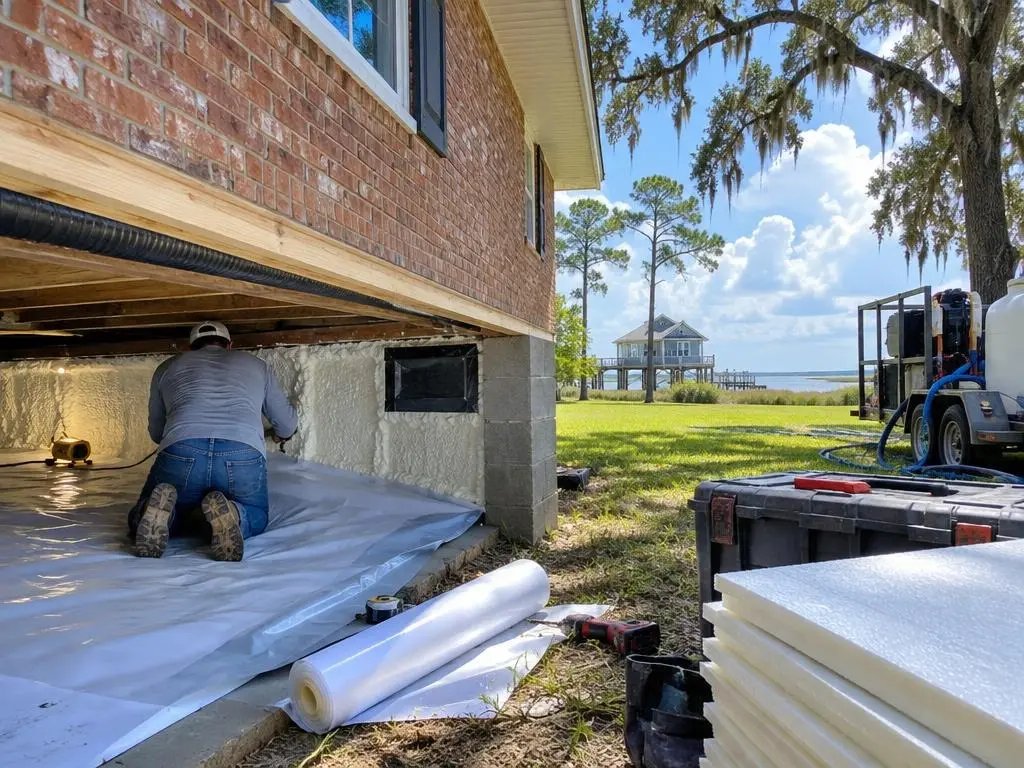
A typical job includes a heavy plastic vapor barrier over the ground, run up the foundation walls and taped at the seams; the foundation vents sealed shut; the access door sealed and insulated; and a plan for keeping the air dry, usually a small amount of conditioned air or a dehumidifier. Then the insulation goes on the walls, often closed-cell spray foam, which handles damp conditions and seals the rim at the same time. Old, wet batts come out first.
Insulating the floor instead
Some crawl spaces are better left vented, for example on homes in flood zones, where the floor must stay open below, or where a sealed crawl space is not practical. Then we insulate the underside of the floor, usually with closed-cell foam sprayed against the subfloor, which seals air and does not hold water. The Department of Energy suggests R-13 for an uninsulated floor in Zone 2.
Termites and inspection access
The 2023 Florida Building Code, Residential (Section R318.8) limits foam plastic on the exterior face or underside of foundation walls in very heavy termite areas, and R318.7 keeps a six-inch gap between grade and exterior wall coverings so termites can be seen. Inside a crawl space, we leave a strip at the top of the wall or a gap at the sill plate where your pest control company needs to see. Talk to your termite provider before encapsulating, since some bond contracts have their own rules.
Water first, then the barrier
If water runs into the crawl space after rain, an encapsulation will not fix that alone. Gutters, downspouts and grading often need attention first, and some crawl spaces need a drain or sump. We tell you what we see and what should come first. Get a free estimate
What Crawl Space Work Covers
We price each part separately so you can see what you are paying for.
Vapor barrier
Heavy plastic over the soil and up the walls, seams taped and sealed.
Vent and door sealing
Foundation vents closed off and the access door sealed and insulated.
Closed-cell wall foam
Spray foam on foundation walls and the rim, with termite inspection strips left open.
Underfloor foam
Closed-cell sprayed under the subfloor where the crawl space stays vented.
Wet batt removal
Fallen, soaked or moldy fiberglass removed and hauled away.
Published Crawl Space Costs
| Job | Range and source |
|---|---|
| Crawl space encapsulation | $3 to $10 per sq ft, $3,000 to $15,000 (HomeGuide) |
| Vapor barrier | $1,200 to $4,000 (HomeGuide) |
| Vent sealing | $150 to $450 (HomeGuide) |
| Closed-cell on crawl space walls | $2 to $5 per sq ft (HomeGuide) |
| Crawl space, spray foam | $2,000 to $4,000 (HomeGuide); $1,000 to $5,900 (Fixr) |
| Closed-cell, installed | $3.00 to $5.00 per sq ft (HomeGuide) |
These are national ranges from HomeGuide's 2026 encapsulation and spray foam guides and from Fixr (2025). Crawl space height, water problems, access and removal change the cost. After we look, the written estimate we hand you is the price.
How a Crawl Space Job Goes
1. Crawl and inspect
We check moisture, wood condition, insulation, ducts, vents and termite clearances.
2. Plan and quote
Encapsulate or insulate the floor, with each part priced separately.
3. Clean out
Wet batts and debris come out first.
4. Seal and insulate
Barrier, vent sealing and foam go in as written.
5. Final check
We show you photos and explain how the space should stay dry.
Crawl Space Encapsulation & Insulation Questions
Should I close the vents on my Tallahassee crawl space?
Only as part of a full plan. Closing vents without a ground barrier and a way to dry the air can make things worse. If the crawl space is encapsulated properly, the vents get sealed.
Why is the insulation falling down under my house?
Usually because humid summer air condenses on the cool floor and the batts soak up the water, get heavy and drop. Replacing them with the same batts tends to repeat the problem.
Will encapsulation affect my termite bond?
It can. Some termite contracts require access to the foundation and sill. Ask your provider before you start, and we will leave the inspection areas they need.
Do I need a dehumidifier after encapsulation?
Most sealed crawl spaces need some way to dry the air, either a dehumidifier or a small supply of conditioned air. We include that in the plan.
Crawl Space Encapsulation & Insulation Service Areas
- Spray Foam Insulation in Tallahassee, FL
- Spray Foam Insulation in Woodville, FL
- Spray Foam Insulation in Crawfordville, FL
- Spray Foam Insulation in Midway, FL
- Spray Foam Insulation in Quincy, FL
- Spray Foam Insulation in Havana, FL
- Spray Foam Insulation in Gretna, FL
- Spray Foam Insulation in Monticello, FL
- Spray Foam Insulation in St. Marks, FL
- Spray Foam Insulation in Panacea, FL
- Spray Foam Insulation in Sopchoppy, FL
- Spray Foam Insulation in Thomasville, GA
- Spray Foam Insulation in Cairo, GA
Get a Crawl Space Encapsulation & Insulation Estimate
Tell us what you smell or see under the house. We will crawl it and send a written plan.